
This Ghardaia travel guide covers the one place in the Algerian Sahara where the architecture is as remarkable as the landscape. Ghardaia is the largest of five fortified towns strung along a dry riverbed 600 kilometres south of Algiers, and together they form the M’Zab Valley — inscribed on the UNESCO World Heritage list in 1982.
What separates the M’Zab from most World Heritage sites is that nobody has moved out. These are not ruins, and they are not a restored heritage quarter. Roughly a quarter of a million people live in the valley, in houses built to a plan laid down a thousand years ago, under a system of community rules that still functions. You are visiting a working town, not an exhibit — and that single fact should shape how you approach the whole trip.
Ghardaia sits at the northern edge of the Sahara, in the Chebka du M’Zab — a fractured limestone plateau that looks, from the air, like cracked pottery. The city is roughly 600 kilometres south of Algiers by road, which is a long day’s drive.
Almost everyone flies. Noumerat – Moufdi Zakaria Airport lies about 19 kilometres south of the city and takes daily domestic flights from Algiers, with the hop lasting a little over an hour. Because the flight is short and frequent, Ghardaia works well as a three- or four-day trip on its own, or as the opening leg of a longer Saharan itinerary.
By road, the route from Algiers runs through Djelfa and Laghouat on the RN1, the trans-Saharan highway. It is a good road and the drive is genuinely interesting — you watch the landscape shed its vegetation over about eight hours — but it costs you a day in each direction. Long-distance coaches cover the same route daily and take ten to twelve hours, which is cheap and perfectly safe but a poor use of holiday time.
Within the valley, shared and private taxis link the five towns for very little money. Distances are short: the furthest of the ksour is a fifteen-minute drive from the centre of Ghardaia.
The valley holds five walled towns, founded between 1012 and 1350 by the Mozabite community — Ibadi Berbers who moved south after the fall of their kingdom at Tahert, in what is now northern Algeria. Each town is built on a hill, each is ringed by a wall, and each is organised the same way: the mosque sits at the summit, its minaret doubling as a watchtower and grain store, and the houses spiral down around it in concentric rings, packed so tightly that the streets between them are barely wide enough for two people.
Ghardaia is the largest and the most commercial. Its arcaded market square is the centre of daily life in the valley, and unlike the other ksour it has spilled well beyond its original walls.
Beni Isguen is the most conservative and the most striking, and is described in more detail below.
Melika sits directly opposite Ghardaia across the wadi and offers the best single panorama of the valley — from its cemetery you see three of the five towns at once. It is also where the tomb of Sidi Aissa stands, with its distinctive clustered forms.
El Atteuf is the oldest, founded in 1012, and holds the mosque of Sidi Brahim — a building whose asymmetric, hand-shaped white forms are the single most photographed piece of architecture in the valley.
Bounoura clings to a steep rock face above the wadi and is the least visited of the five, which is precisely its appeal.
You can see the outside of all five in a long day. Understanding any of them takes longer.
Beni Isguen, founded in 1347, is the ksar that most visitors remember. It is still enclosed by its wall, still gated, and still governed by its own rules. Those rules matter, and you should know them before you arrive rather than discover them at the gate.
The town closes at sunset. Non-residents are admitted during daylight only, and in practice you want to be at the gate well before four in the afternoon — arriving later means either a rushed visit or none at all. A guide from the community accompanies every visitor: this is not an upsell, it is how access works. Outsiders do not stay overnight inside the walls. Dress is expected to be modest for everyone, and photography is restricted in parts of the town, particularly where people are present. Your guide will tell you where a camera is welcome and where it is not, and the answer is not negotiable.
The reward for accepting all of this is one of the most intact medieval urban environments in North Africa, plus something genuinely rare: the late-afternoon auction market. Sellers walk a circuit through the square holding up carpets, jewellery, tools and household goods, calling the current bid aloud. Buyers signal. The system has run for centuries and it runs fast. Even if you buy nothing, standing at the edge of that square for half an hour tells you more about how this community works than any museum could.
Ghardaia’s main square is arcaded on all four sides and slopes gently, which means the whole space is visible from almost anywhere in it. Mornings are for produce and daily goods. Later in the day the carpet sellers come out, and the covered passages behind the arcades hold the craft workshops: dinanderie — worked copper and brass — alongside silversmiths making the heavy geometric jewellery of the region.
M’Zab carpets are worth understanding before you buy. The traditional pieces are wool or goat hair, woven by women, with geometric motifs in undyed cream and brown or in strong reds. Quality varies enormously, and the difference between a handwoven piece and a machine-made import is not always obvious to a visitor. As a rough guide, a medium handwoven carpet sits somewhere between 80 and 300 euros depending on size, wool quality and the fineness of the weave — but treat that as an order of magnitude, not a price list. Ask your guide to come with you, ask to see the back of the carpet, and be prepared to spend real time on it. Buying well here takes an hour, not five minutes.
If your dates are flexible, aim for March. Ghardaia has held an annual carpet festival for more than half a century, and it is the one moment when the valley’s defining craft is on public display rather than folded in the back of a shop.
Weavers come in from across the M’Zab and the surrounding wilaya. There are competitions, demonstrations of the whole chain from fleece to finished piece, and a market far larger than the usual daily one. It is also the best chance a visitor will ever get to see the difference between grades of work laid side by side, which is exactly the knowledge you need if you intend to buy.
Exact dates shift from year to year and are announced locally rather than internationally. Ask us when you enquire and we will tell you what we know for your travel window.
Below each ksar lies a palm grove, and inside each grove is a second, looser town. Mozabite families traditionally keep a summer house among the palms and move down to it during the hottest months, leaving the walled town largely empty.
The groves are watered by a flood-management system that is one of the quiet engineering achievements of the pre-industrial Sahara. The wadi flows only after rain, and rarely — but when it does, a network of dams, channels and distribution combs spreads the water across the groves and into wells, sharing it between families according to rights fixed generations ago. Elsewhere in the Algerian Sahara the same problem is solved by foggara, underground galleries that tap groundwater and carry it by gravity to the surface; both systems are governed by committees whose authority over water rights long predates the modern state. Walking through a grove with someone who can point out the dividing stones is the moment the valley stops being picturesque and starts being impressive.
Between the palms, families grow vegetables, cereals and fruit trees in the shade of the date palms — a layered system that gets several crops out of one allocation of water.
UNESCO’s own citation notes that the M’Zab has influenced Arab architecture and town planning for nearly a millennium, and names three twentieth-century figures directly: Le Corbusier, Fernand Pouillon and Andre Raverau.
What drew them was not decoration — there is almost none — but the logic. Every house is a variation on the same cubic cell. Streets are narrow because narrow streets stay shaded. Walls are thick because thick walls hold cool air overnight. Terraces are enclosed because families use them. Windows are small and high. The result is a settlement that is comfortable in 45-degree heat without machinery, and that expresses an egalitarian social structure in built form: no house dominates, no house is allowed to take another’s light.
If you have any interest in architecture, bring a notebook. If you have none, you will still notice that the temperature drops several degrees the moment you step into the old town.
The people of the valley are Berber and follow Ibadi Islam, a branch distinct from both Sunni and Shia traditions. They speak Tumzabt, a Berber language, alongside Arabic. Their ancestors moved south into this deliberately inhospitable plateau in the eleventh century, and the austerity of the site was part of the point — it offered isolation and defensibility.
The community is organised around religious and civic councils of notables that still hold real authority over matters ranging from construction to commerce to marriage. Mozabite merchants have historically run trading networks across Algeria, and many families have members working in Algiers or Oran while keeping the house in the valley.
As a visitor, the practical implication is straightforward: this is a conservative society that has chosen to remain so, and it receives guests warmly on that basis. Cover shoulders and knees, ask before photographing anyone, accept tea when it is offered, and take your guide’s cues on where to go and what to ask. Do that and you will find the welcome genuine.
October to April. Daytime temperatures in that window sit comfortably between 15 and 25 degrees, which is close to ideal for walking the ksour. Between May and September they regularly pass 40 and touch 45, and sightseeing on foot becomes unpleasant well before it becomes unsafe.
The best months are November through March. Days are warm and clear, nights are cold — in December and January they drop to 5 to 10 degrees, and can feel colder still in the wind. Pack a proper jacket. Visitors consistently underestimate this, arriving with clothes for a desert and none for a desert night.
Rain is rare but not impossible, and when it comes it can be heavy. Flash flooding in the wadi is a real phenomenon and the reason the flood-control system exists.
Two very different numbers, depending on how you travel.
Independently, a visitor spending on guesthouses, local restaurants, taxis and occasional guides lands somewhere around 60 to 100 euros a day. That assumes you have already sorted your own transport to Ghardaia, speak enough French or Arabic to negotiate, and are comfortable arranging a Beni Isguen guide at the gate.
On an organised circuit, expect roughly 150 to 220 euros per person per day depending on comfort level, group size and whether the itinerary includes desert nights. That figure covers transport, a licensed guide throughout, accommodation, full board, permits and site entries — the things that individually eat both money and time.
Both ranges are indicative and move with the season, the exchange rate and group size. For a firm figure on our own itineraries, see the M’Zab Valley tour or ask us directly.
Guesthouses and family-run hotels in and around the palm groves are the best value in the valley, typically in the range of 15 to 30 euros a night with breakfast. They are quieter and cooler than the roadside options, and they put you inside the landscape rather than beside it. Facilities are simple; the hospitality rarely is.
Mid-range hotels in Ghardaia city run roughly 60 to 120 euros, with a restaurant, air conditioning and sometimes a pool. This is the sensible choice in the shoulder season or if you are travelling with children.
Desert camps and lodges outside the valley start around 150 euros and are priced per experience rather than per room: Berber tents, dinner cooked on site, and a night under a sky with no light pollution for hundreds of kilometres in any direction.
Whatever the bracket, book ahead for March — the carpet festival fills the town.
The valley is the reason to come, but it is small, and most visitors want a day in open desert.
Camel treks are the classic option. A half-day ride out to the dunes and back runs somewhere around 40 to 60 euros; a two-night bivouac with a guide, camels, camp and full board is more like 150 to 250 euros per person. The short version is enough for most people; the long one is a genuinely different experience.
The Sebseb dunes lie about an hour from Ghardaia and give you classic erg scenery — sand, not plateau — without a long drive. Late afternoon is the time to go.
Metlili, south of Ghardaia, is a Chaamba town with a different character and a different history from the Mozabite ksour, and makes a useful half-day contrast.
Palm grove and foggara walks take two or three hours and are the cheapest excursion of the lot, but need someone who can explain what you are looking at. Without a guide it is a pleasant walk among palms; with one it is a lesson in how the Sahara was made habitable.
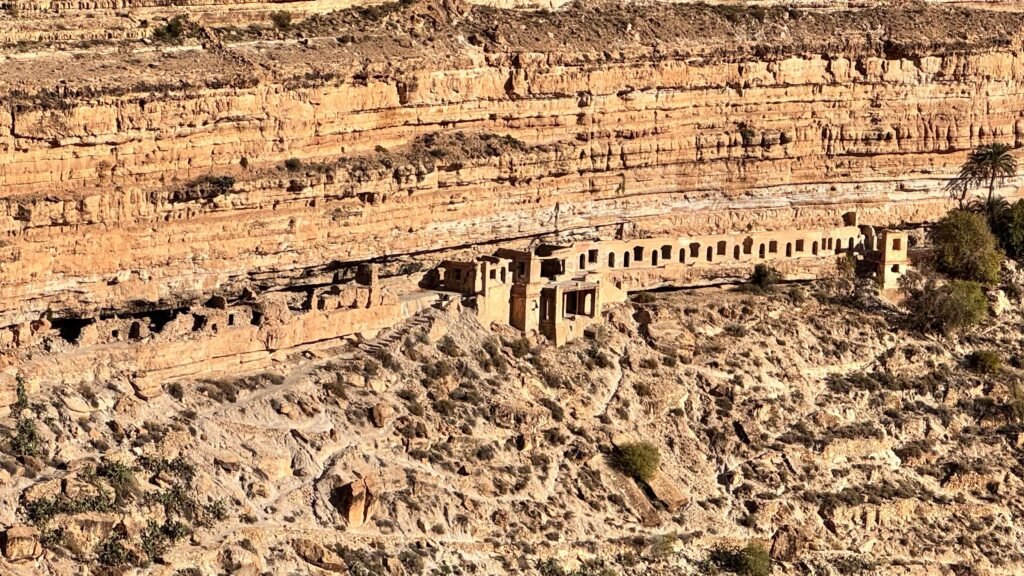
The Brezina canyons, west in El Bayadh wilaya, are a longer excursion but a spectacular one: cliff-side ksour, permanent water, and a landscape that almost no foreign visitor sees. Our M’Zab Valley tour pairs the two regions across five days for exactly this reason.
El Menia (formerly El Golea), further south on the RN1, has a ruined hilltop ksar and marks the transition into the deep Sahara.
Three days. Day one, arrive and walk Ghardaia’s market square and old town in the late afternoon. Day two, Beni Isguen with a local guide in the morning, the auction market at the end of the day, Melika viewpoint in between. Day three, El Atteuf and Bounoura in the morning, the Sebseb dunes for sunset, depart the following morning.
Five days. The same first three, then two days west into the Saharan Atlas for the canyons, the cliff ksour and the oases around El Bayadh, returning by air from there.
Three to four days is the right length for the pentapolis on its own. Add one or two nights if you want to sleep in the desert rather than look at it.
Money. Carry cash. Card acceptance outside major hotels is limited across southern Algeria, and cash machines thin out quickly once you leave the centre of Ghardaia — draw what you need before heading to the smaller ksour or into the desert.
Fridays. Many shops close during the midday prayer and some do not reopen. Plan Friday around walking and viewpoints rather than markets.
Food. Look for merdoum — meat slow-cooked in an underground pit — which is a M’Zab speciality and usually needs to be ordered in advance. Dates from the local groves are excellent and travel well.
Guides. A local guide is required for Beni Isguen and strongly advisable everywhere else. The ksour are not signposted and their streets are not laid out for strangers.
Photography. Ask first, everywhere, and expect a firm no inside Beni Isguen and around women anywhere in the valley.
Visas. Most nationalities need a visa for Algeria, and the application requires an invitation letter from a licensed local agency. We issue one for every confirmed booking. The rules differ between the northern and southern wilayas, so read our Algeria visa guide before you book flights.
Yes. The M’Zab is one of the calmest regions in Algeria and receives Algerian visitors year-round. The practical risks are heat, dehydration and cold nights in winter, not security. Travel with a licensed agency, as the law requires for organised tours, and follow your guide’s instructions inside Beni Isguen.
Roughly 60 to 100 euros a day travelling independently, or 150 to 220 euros a day on an organised circuit that includes transport, guide, accommodation, meals and permits. Flights from Algiers are extra in both cases.
March, and it has run annually for over fifty years. The exact dates are set locally and change each year, so confirm before booking flights around it.
Access varies by building and is decided by the community rather than by tourism authorities. Some ksour allow visitors into the mosque courtyard with a guide; others do not. Ask rather than assume, and accept the answer.
Three full days covers the five ksour, the market and the dunes without rushing. Two is possible but you will skip something. Five lets you add the canyons and oases of El Bayadh to the west.
November, February and March are the sweet spot: warm days, tolerable nights, clear light. December and January are equally good during the day but genuinely cold after dark. March adds the carpet festival.
Inside Beni Isguen, yes — a guide from the community is required for entry. Elsewhere it is optional but strongly recommended: the ksour are unsignposted mazes and a guide is the difference between photographing walls and understanding a town.
If you want dunes, go to Taghit or Timimoun — the M’Zab is a rock plateau and its sand is an hour’s drive away. If you want to understand how people have actually lived in the Sahara for a thousand years, there is nowhere better in Algeria, and few places better anywhere.
It is also the easiest introduction to the Algerian Sahara: short flight, comfortable accommodation, no trekking, and a landscape that starts working on you the moment you leave the airport.
Ready to plan? Contact us for departure dates, see the full M’Zab Valley itinerary, or compare it with our other Algeria tour packages. If you are heading further south afterwards, the Djanet travel guide covers the Tassili n’Ajjer.