
This Constantine travel guide covers a city that has no real equivalent anywhere in the Mediterranean. Constantine is built on a limestone rock that a river has cut in two. The Rhumel gorge runs straight through the middle of the city, and the two halves are joined by bridges — six of them, spanning two centuries of engineering, from an eighteenth-century stone crossing to a cable-stayed span opened in 2014.
It is Algeria’s third-largest city, home to close to a million people across the agglomeration, and it sits at 640 metres above sea level, about 80 kilometres inland from the Mediterranean. Photographs never quite convey it, because a photograph cannot give you the drop.
Constantine travel guide: the essentials
- Best season. March to June and September to November. Winters are cold and wet.
- Getting there. One hour by air from Algiers to Mohamed Boudiaf International, or five to six hours by motorway.
- Visa. Northern Algeria requires a consular visa obtained in advance. Visa on arrival does not apply here.
- How long. Two days for the city, three with Djemila.
- Do not miss. Crossing the Sidi M’Cid bridge on foot in the hour before sunset.
- Difficulty. Easy but steep. This is a city of stairs and gradients.
How to get to Constantine
Mohamed Boudiaf International Airport serves the city with domestic flights from Algiers and a number of international routes, mostly to France. Flying from Algiers takes about an hour.
The train from Algiers is a reasonable alternative if you have the time — the line runs east through the Kabylie foothills and Setif, and it is a comfortable way to see the interior. By road the drive is roughly five to six hours on the east–west motorway.
One point of paperwork that catches people out: northern Algeria requires a consular visa obtained in advance. The visa-on-arrival scheme applies only to the southern Saharan wilayas. If Constantine is your entry point, start the application early — our Algeria visa guide sets out the process and the invitation letter we issue.
The bridges, one by one
Understanding Constantine means understanding why it needed so many bridges, and the answer is that the gorge is not a river valley you can walk around. It is a cleft with vertical walls, and the city grew on both sides of it.
Bab El Kantara is the oldest crossing in use, rebuilt in 1792 on the site of a Roman bridge. It carries traffic north out of the old town, and it is the historical gate of the city.
Sidi M’Cid Bridge, opened in 1912, is the one on every postcard. It is a suspension bridge with a span of 168 metres, hung high above the gorge floor between two stone pylons, and walking across it is the single most memorable thing you will do in Constantine. It links the old town to the hospital plateau and the war memorial on the far cliff.
Sidi Rached Viaduct, also 1912, is a masonry viaduct 447 metres long carried on 27 arches, designed by the French engineer Paul Sejourne. It is among the largest stone bridges ever built, and from below it looks less like infrastructure than like an aqueduct that wandered into the wrong century.
The Mellah Slimane footbridge and the Falls Bridge, both 1925, handle pedestrians and the lower crossings near the waterfalls where the Rhumel disappears into the rock.
Salah Bey Bridge, opened in 2014 and designed by the Danish practice Dissing+Weitling, is the city’s first cable-stayed bridge and its modern signature. Seeing it alongside the 1912 viaduct in a single frame is the clearest statement of what Constantine is: a place that has been solving the same problem, in the technology of the day, for two thousand years.
Walking the gorge
Do this on your first evening, before anything else. Start at the Sidi M’Cid bridge, cross on foot, and follow the rim path on the far side toward the war memorial. The light in the last hour before sunset moves down the gorge walls and turns the limestone from grey to gold, and the sound of the river reaches you from a long way below.
There is also a path down into the gorge itself, along the old chemin des touristes, which passes beneath the arches and behind the waterfalls. Its condition varies and sections have been closed for repair at different times, so ask locally before committing to it. When it is open, it is spectacular.
Wear proper shoes for all of this. Constantine is a steep city and the pavements are uneven.
Cirta: the city before Constantine
Long before the Romans, this rock was Cirta, capital of Numidia and seat of the Berber kings Syphax and Massinissa. The defensive logic is obvious the moment you look at the site: a plateau with sheer drops on three sides, water at the bottom, and one approach to guard.
The Romans took the city and it prospered. In 313 AD it was rebuilt and renamed Constantina after the emperor Constantine, and the name stuck through the Arab conquest of the eighth century, when it became Qacentina, and through Ottoman and French rule to the present day.
What you see today is largely Ottoman and French colonial fabric layered on that older foundation. Constantine served as Arab Capital of Culture in 2015, which funded a wave of restoration work whose effects are still visible.
The Ahmed Bey Palace
This is the building to give proper time to. Ahmed Bey was the last bey of Constantine, ruling from 1826 until the French took the city in 1837, and the palace he built for himself is one of the finest Ottoman residences surviving in North Africa.
It is organised around courtyards and gardens rather than corridors, with painted ceilings, imported marble, and tiled walls whose panels depict the pilgrimage journeys of the bey. The scale is domestic rather than monumental, which makes it more affecting, not less: you are walking through a house, not a state building.
Allow at least two hours. Photography rules vary by room, so check on entry.
Souika and the old town
Souika is the historic quarter below the Sidi Rached viaduct — a dense network of stepped lanes, workshops and small mosques that is the closest thing Constantine has to a casbah. Parts of it have suffered from years of neglect and some buildings are in poor condition, but the quarter is alive and the restoration effort is ongoing.
Go with a local guide. The lanes are not signposted, the levels are confusing, and having someone who can knock on the right door turns a walk into a visit.
Mosques and museums
The Great Mosque dates to 1136 and is the oldest in the city, built with columns reused from Roman buildings.
The El Bey Mosque, also known as Souk El Ghezel, was completed in 1703 and stands on the square of the same name.
The Emir Abdelkader Mosque is modern and enormous — a university mosque with twin minarets that dominates the newer part of the city and is among the largest in Africa.
The Cirta Museum holds the archaeological collection from the region: Numidian material, Roman mosaics and statuary, and finds from the sites you can visit nearby. Go here before you go to Djemila or Tiddis rather than after — it makes the ruins legible.
Malouf: the sound of the city
Constantine is the home of malouf, the Algerian branch of Andalusian classical music, brought west by families displaced from Seville and preserved here for centuries. It is played on oud, violin, darbouka and tar, in suites that build slowly across long sets.
Ask locally whether anything is on while you are in town — malouf is performed at cultural centres and at private celebrations, and hearing it in Constantine is different from hearing a recording anywhere else. The city also produced Malek Haddad and a long line of writers and musicians, and it takes that lineage seriously.
Eating in Constantine
Constantine has a distinct culinary identity worth seeking out. Chakhchoukha constantinoise is the dish the city is known for: torn flatbread soaked in a spiced lamb and chickpea sauce, served in a mound. Trida is a related dish built on small squares of pasta. Both are heavy, both are winter food, and both are usually better in a family setting than a restaurant — if you are invited, accept.
The pastry tradition here is also strong, particularly the honey-and-almond varieties sold around Souk El Ghezel.
Day trips from Constantine
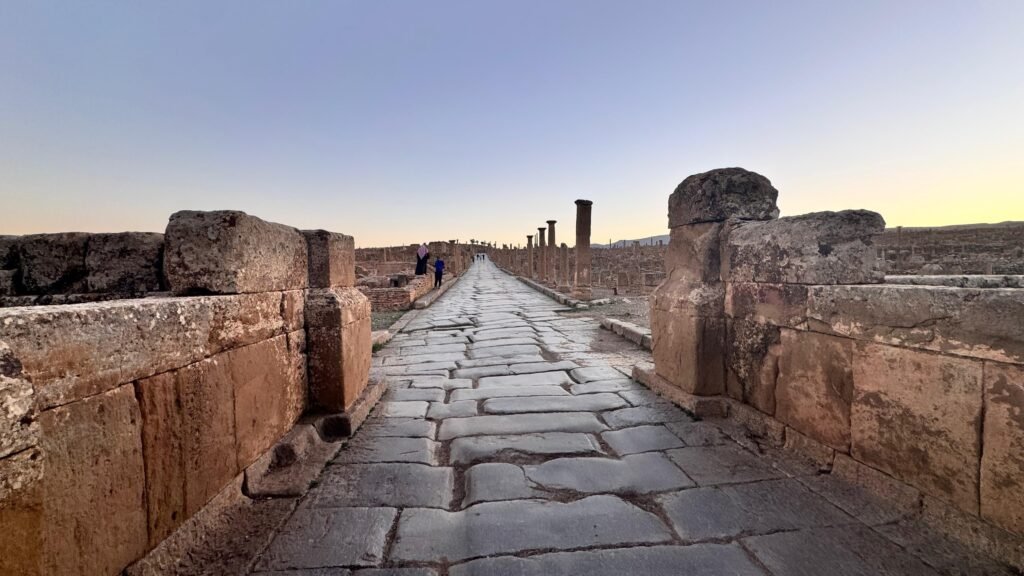
Djemila, about 90 kilometres west, is one of the best-preserved Roman cities in North Africa and a UNESCO World Heritage site. It sits in a mountain setting at around 900 metres, which is unusual for a Roman colony and gives it a character quite different from the coastal sites. The Severan temple, the forum and the mosaics in the on-site museum are the highlights. Give it a full day.
Tiddis is closer, about 30 kilometres northwest, and far less visited. It is a Roman town built on a steep red hillside in terraces, and its position is arguably more dramatic than Djemila’s even if less of it survives.
Timgad, south in Batna wilaya, is a longer drive but the most complete Roman city in the country. Constantine, Djemila and Timgad together make a strong five- or six-day Roman North Africa itinerary, and it is one of the combinations we build most often — the Batna travel guide covers that leg in detail.
When to visit
March to June and September to November. Constantine is not a desert city — it gets real winters, with cold rain and occasional snow, and the altitude means the wind on the bridges in January is genuinely unpleasant. July and August are hot and the city empties.
Spring is the best of it. The gorge has water in it, the surrounding countryside is green, and the light is at its most forgiving for photographs.
Three days in Constantine
Day 1. Arrive, walk the Sidi M’Cid bridge and the rim path, see the gorge from both sides in the late afternoon light.
Day 2. Ahmed Bey Palace in the morning, Souika and the Great Mosque before lunch, the Cirta Museum in the afternoon, Souk El Ghezel at the end of the day.
Day 3. Djemila, with an early start and a packed lunch, returning in the evening.
That is the shape of our Constantine city of bridges tour. Extend it by two days and you can add Timgad and the Aures.
Constantine travel guide: common questions
How many bridges does Constantine have?
Six are in use and define the city: Bab El Kantara (1792), Sidi M’Cid and the Sidi Rached viaduct (both 1912), the Falls Bridge and the Mellah Slimane footbridge (both 1925), and the Salah Bey cable-stayed bridge (2014).
Is Constantine worth visiting?
If you have any interest in cities, engineering or Ottoman architecture, yes. It is the most dramatically sited city in Algeria and the natural base for Djemila, Tiddis and Timgad. If you have come for dunes, it is the wrong end of the country.
How many days do you need in Constantine?
Two days covers the bridges, the Ahmed Bey Palace, Souika and the museum. A third day lets you add Djemila. Five to six days makes a full Roman circuit with Timgad and the Aures.
Do you need a visa for Constantine?
Yes, and it must be obtained from an Algerian consulate before you travel. The visa-on-arrival scheme covers only the southern Saharan wilayas, not the north. We issue the invitation letter the application requires.
What is the best time of year to visit Constantine?
Spring, from March to June, is the strongest window: green countryside, water in the gorge and comfortable temperatures. September to November is the second choice. Avoid deep winter for the wind and July and August for the heat.
Practical notes
Terrain. This is a steep, stepped city. If mobility is a concern, tell us in advance and we will adjust the route — several of the best viewpoints are reachable by vehicle.
Dress. Constantine is a conservative and quite formal city by Algerian standards. Modest dress is appreciated, particularly around mosques and in the old quarters.
Photography. The bridges and the gorge are fine. Ask before photographing people, and be aware that some public buildings and installations should not be photographed at all — your guide will tell you which.
Money. Cash, as everywhere in Algeria outside major hotels.
Constantine is where we would send a first-time visitor to Algeria who is more interested in cities and history than in dunes. It is also the natural pairing for the Roman sites of the east. Contact us to build it around your dates, or compare it with our other Algeria tour packages.
One Response